SALE
 Adventure
Southern Voyager
7 Days
Departs Christchurch
For 18 to 39 year olds
5% OFF
From $1,990 NZD$2,095 NZD
By Agung White published on 20 October 2026
Choosing a small group tour company in New Zealand comes down to six things: how big the group actually is, whether the operator is safety-certified, whether its sustainability claims check out, what's genuinely included in the price, how flexible the cancellation policy is, and what independent reviewers (not the company's own website) say. Get those six answers before you hand over a deposit and you'll avoid the two most common regrets, a "small group" that's really 30 people on a coach, and a price that balloons once you add back everything that wasn't included.
There are dozens of operators running near-identical routes between Auckland and Queenstown, and the marketing tends to blur together after the third brochure. This is the checklist we'd actually use, written as an operator ourselves and as people who've sat through the sales pitches of a few competitors while researching our own routes.
There's no legal definition, which is exactly why the term gets stretched. In practice, "small group" tours in New Zealand range from around 10 travellers up to 24 or more on a standard coach. Some companies market 30-plus seat buses as "small group" simply because it's not a 50-person cruise-ship excursion.
If group size matters to you (and for most people booking a small group tour instead of a bus pass, it's the whole point), ask for the maximum number of guests per departure in writing, not the average. Wild Kiwi caps every Adventure and Premium departure at 18 guests, which is closer to the tighter end of the market and small enough that you'll actually know everyone's name by day three.
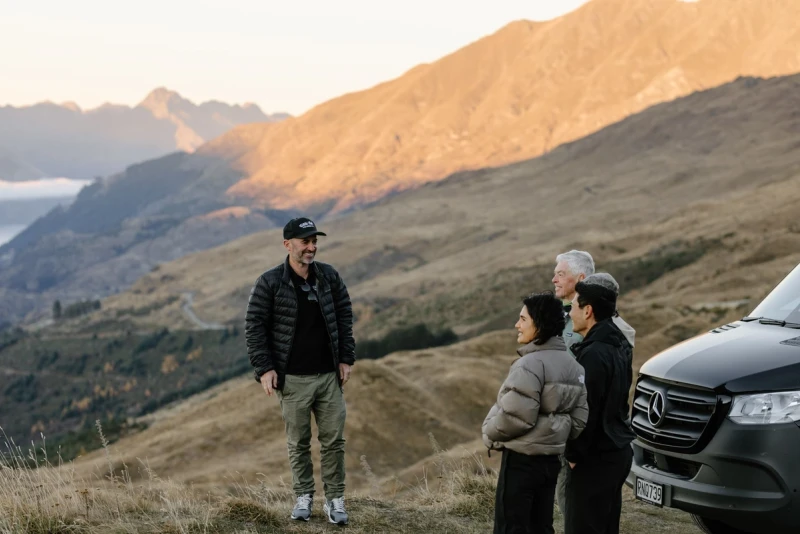
Group size only tells half the story. A 24-person group with two crew (a driver and a separate guide) runs very differently to the same group with one person doing both jobs at once. Ask specifically:
None of these are trick questions, and an operator with nothing to hide will answer them without hesitating.
This is the one most travellers never think to check, and it's the easiest to verify independently. Under the Health and Safety at Work (Adventure Activities) Regulations 2016, any commercial operator running activities like rafting, canyoning, or guided walks with inherent risk has to be registered with WorkSafe New Zealand and hold a current safety audit. WorkSafe keeps a public register of adventure activity operators, it takes thirty seconds to search a company name before you book (as of September 2026).
Separately, look for Qualmark endorsement. It's New Zealand's official tourism quality mark, built around three things: environmental practice, safety, and genuine hospitality, with businesses graded Bronze, Silver, or Gold. It's not compulsory, so its absence isn't automatically a red flag, but its presence means an independent assessor has actually checked the operator's safety systems rather than taking their word for it.
"Eco-friendly," "sustainable," and "responsible" appear on almost every tour operator's homepage in New Zealand, and most of it is unverified marketing copy. The way to tell the difference is to look for third-party certification rather than a paragraph of adjectives.
B Corp is the most rigorous version: it's an independent assessment by the non-profit B Lab across a company's impact on workers, community, environment, and governance, and the certification (and the underlying score) is published publicly. You can look any certified company up on B Lab's directory. Wild Kiwi was certified in January 2026 with a B Impact Score of 89.4. The qualifying threshold is 80, and B Lab lists the median score across all businesses that complete the assessment at 50.9, so it's a genuinely meaningful gap, not a rounding exercise.
If an operator can't point you to a specific certification, register, or published score, treat the sustainability language as marketing until proven otherwise.
This is where small group tours in New Zealand differ most, and where quoted prices become hard to compare directly. Two operators can advertise a similar 7-day North Island price with genuinely different inclusions underneath. Before comparing prices side by side, confirm:
What to check
Usually included
Often extra
Ask for the exact inclusions list in writing and do the maths on what a fully-loaded price would look like once you add the activities you actually want to do, not just the headline number.

A small group tour isn't automatically the right answer, and an operator being upfront about that is a good sign of trustworthiness rather than a weakness. It genuinely suits people who want the driving, logistics, and activity bookings handled, and who'd rather travel with a ready-made group of similarly-aged people than figure it out alone (we've written more on why that trade-off works so well for solo travellers specifically). If you want total freedom to change your route on a whim, or you're set on a rigid work-from-the-road schedule with your own vehicle, a self-drive campervan trip will probably suit you better. We've laid out that comparison in detail separately.
Backpacker hop-on-hop-off buses sit in between: cheaper and more flexible than a fixed small group tour, but you're managing your own accommodation and activity bookings at every stop, and there's no guide curating the experience or the group.
Ask this before you pay a deposit, not after something goes wrong. Specifically: what's refundable and by when, can you transfer to a different departure date for free, and what happens if the company cancels a departure due to low numbers (a real risk with smaller, more selective operators). A policy that's vague on any of these three is worth pushing on, because "flexible" without specifics usually means flexible in the operator's favour.
Testimonials on a company's own website are curated by definition, nobody publishes their worst review on their homepage. Cross-check independent platforms like Google Reviews and TripAdvisor instead, and look specifically for:
For reference, Wild Kiwi currently sits at 4.9 out of 5 across more than 600 Google reviews and over 1,200 on TripAdvisor, which is the kind of volume that's harder to fake than a curated quote wall.
Before you put down a deposit with any small group tour company in New Zealand, get straight answers on:
You'll still want to factor in entry costs on top of the tour price itself, every visitor needs an NZeTA and pays the New Zealand International Visitor Levy, currently NZD $100 (as of September 2026), we've broken that down fully in our visa and entry requirements guide.
If group size and guide quality are your main filters, our Southern Voyager (7 days, South Island, from $2,025 NZD) and Northern Voyager (7 days, North Island, from $1,980 NZD) are good ways to try small-group travel without committing to a multi-week trip, both cap at 18 guests with the same guide the whole way through. If you'd rather see both islands in one trip once you've done the comparison shopping, our NZ Explorer (14 days, from $4,085 NZD) covers the country end to end. We're B Corp certified and Qualmark endorsed, our maximum group size is 18 across every departure, and we'd rather you ask us the awkward questions above before booking than after.
Most operators marketed as "small group" run between 10 and 24 guests. Under 20 is a reasonable benchmark if you want to actually get to know everyone on the trip. Always ask for the maximum per departure in writing rather than relying on marketing language, since "small group" isn't a regulated term in New Zealand tourism.
It depends on what you're optimising for. A small group tour costs more but bundles accommodation, activities, and a guide into one price with no logistics to manage. A backpacker bus like a hop-on-hop-off pass is cheaper and more flexible, but you're booking your own beds and activities at every stop, with no curated group experience.
Search the company on WorkSafe's public register of adventure activity operators if they run activities directly, look for independent certifications like B Corp or Qualmark rather than self-described claims, and cross-check reviews on Google and TripAdvisor rather than relying only on testimonials on the operator's own website.
Lunch and dinner, alcohol, optional adventure activities like bungy jumping or skydiving, and single-room upgrades are the most common extras. Confirm the exact inclusions list in writing before comparing prices between operators, since headline prices can hide very different inclusions.
Yes. Solo travellers typically make up a large share of small group tour bookings in New Zealand, since the format is built around meeting people rather than travelling with a group you already know. Most operators pair solo travellers in twin rooms by default, with a private room available for an extra fee if you'd rather not share.
For New Zealand summer departures (December to February), booking 4-6 months ahead gives you the best choice of dates, since popular routes and Great Walk-linked itineraries sell out earliest. Shoulder season trips (autumn and spring) usually have more availability closer to departure.
Adventure Adventure
 Premium
 Premium
 Adventure
 Premium
 Adventure
 Premium
 Premium
 Adventure
 Adventure
 Premium
 Premium
 Adventure
 Premium
 Premium
 Adventure
 Adventure
 Adventure
 Premium
 Adventure
 Adventure
 Adventure
 Adventure
 Premium
 Day
 Day
 Day
 Day
 Day
Opening Hours:
8:30am - 5:00pm
Address:
127 Franklin Road
Freemans Bay
Auckland 1011, NZ
Phone:
Email:
Opening Hours:
8:30am - 5:00pm
Address:
127 Franklin Road
Freemans Bay
Auckland 1011, NZ
Phone:
Email: